Your marketing team wants a familiar editor. Your product team wants one codebase for auth, APIs, and admin workflows. Both claim "headless" or "Laravel CMS" will fix the split. They solve different problems.
This comparison helps product teams choose between headless WordPress and a Laravel CMS such as LaraDashboard. You will see where each stack wins, what it costs to operate, and how to decide without a rewrite regret.
For the broader platform debate, start with our Laravel vs WordPress guide. For why teams leave plugin-heavy WordPress, read why developers move to Laravel. Here the focus is headless WordPress versus a Laravel-native CMS for product work.
The short answer
Pick headless WordPress when editors must stay in wp-admin, content volume is high, and your product logic already lives (or will live) in a separate app. WordPress remains the content API. Your frontend or mobile clients consume REST or GraphQL.
Pick a Laravel CMS when product, admin, and content should share one Laravel app. You want models, policies, queues, and editorial UI in the same deploy. You accept training editors on a new admin in exchange for one ownership model.
Neither choice is "more modern" by default. Headless WordPress adds network hops and two security surfaces. A Laravel CMS asks your team to own content features that WordPress plugins used to provide.
Disclosure: LaraDashboard is our open-source Laravel admin and CMS. We recommend it when you want a self-hosted, Laravel-native back office. The decision framework below still applies if you use Filament, Nova, or a custom Laravel admin.
What each architecture actually means
Headless WordPress
WordPress stores posts, media, users, and often custom fields. Themes do not render the public site. A separate frontend (Next.js, Nuxt, mobile apps, or even a Laravel Blade app) fetches content over the WordPress REST API or WPGraphQL.
Editors keep the classic or block editor. Engineers build product features outside WordPress. You often add a preview bridge, webhook invalidation for caches, and careful auth between systems.
Laravel CMS
Content lives in your Laravel database as models (posts, pages, media, taxonomies). Admins edit through Livewire, Inertia, or Blade UI. Public pages may be server-rendered from the same app, or you expose APIs with Sanctum for a separate frontend.
LaraDashboard follows this pattern: modular Laravel CMS with roles, media, forms, and related product modules in one stack. You deploy one application. You still choose hosting, backups, and hardening yourself.
Easy to confuse: "WordPress with a Laravel frontend"
Some teams keep WordPress for marketing URLs and put the SaaS in Laravel. That is a split stack, not always full headless. Headless means WordPress is primarily an API. Hybrid means WordPress still owns many public pages while Laravel owns the product.
Be precise in planning docs. Budget and SEO work differ a lot between true headless and a simple marketing-plus-app split.
Decision criteria product teams should score
Use a shared scorecard. Weight what your roadmap cares about this year.
Editor experience and training
Headless WordPress wins if your writers already know Gutenberg, ACF, or Yoast workflows. Change cost is low for content ops. You pay later in preview complexity and "why does staging look different from production" tickets.
Laravel CMS wins if editors can learn a cleaner admin tied to your domain language. Client portals, custom statuses, and role-based screens map to Spatie permissions and your own forms. Training is real work. Document it.
Product logic and data model
If checkout, tenancy, approvals, and billing are the product, they do not belong in WordPress hooks long term. Headless lets you isolate that logic in Laravel (or another app) while WordPress holds articles and landing copy.
If content types are part of the product (case workflows, ticket-linked docs, CRM notes beside posts), a Laravel CMS keeps joins and policies in one schema. Custom post types and postmeta get awkward when reporting needs real foreign keys.
API and mobile clients
WordPress REST is fine for many content payloads. Custom endpoints, versioning, and partner auth often turn into plugin soup. Laravel treats APIs as first-class routes. Sanctum, rate limits, and OpenAPI tooling sit next to your domain code.
Headless WordPress still needs a strong product API somewhere. Do not assume WP REST replaces your application API.
SEO and URL ownership
Classic WordPress themes control URLs, sitemaps, and redirects in one place. Headless splits that across CMS, frontend framework, and CDN. You must own redirects, canonical tags, preview auth, and cache purge on publish. Teams that skip this lose rankings during launches.
A Laravel CMS that renders public pages keeps SEO closer to one router and one sitemap generator. If you go Laravel API + separate Next.js site, you inherit the same headless SEO checklist as WordPress headless. The CMS brand does not remove that work.
See our guide on rebuilding in Laravel without losing rankings when URLs must survive a cutover.
Security and operations
Headless WordPress: two apps to patch (WordPress + frontend), two deploy pipelines, plugin risk on the CMS, and origin hardening for the API. You also secure the bridge tokens between systems.
Laravel CMS: one app surface if you keep content and product together. You still must harden the host. Read our self-hosted Laravel CMS security series for firewalls, auth, backups, and rate limits.
Count CVE response time and who is on call. "Fewer logos" is not automatic safety. Ownership is.
Hiring and team shape
Agencies with strong WordPress editors and separate JS frontend teams often prefer headless WordPress. Product companies hiring Laravel engineers often prefer one Laravel CMS and fewer specialists.
Ask who will debug a failed preview build at 5pm. That answer predicts the better architecture more than a feature matrix.
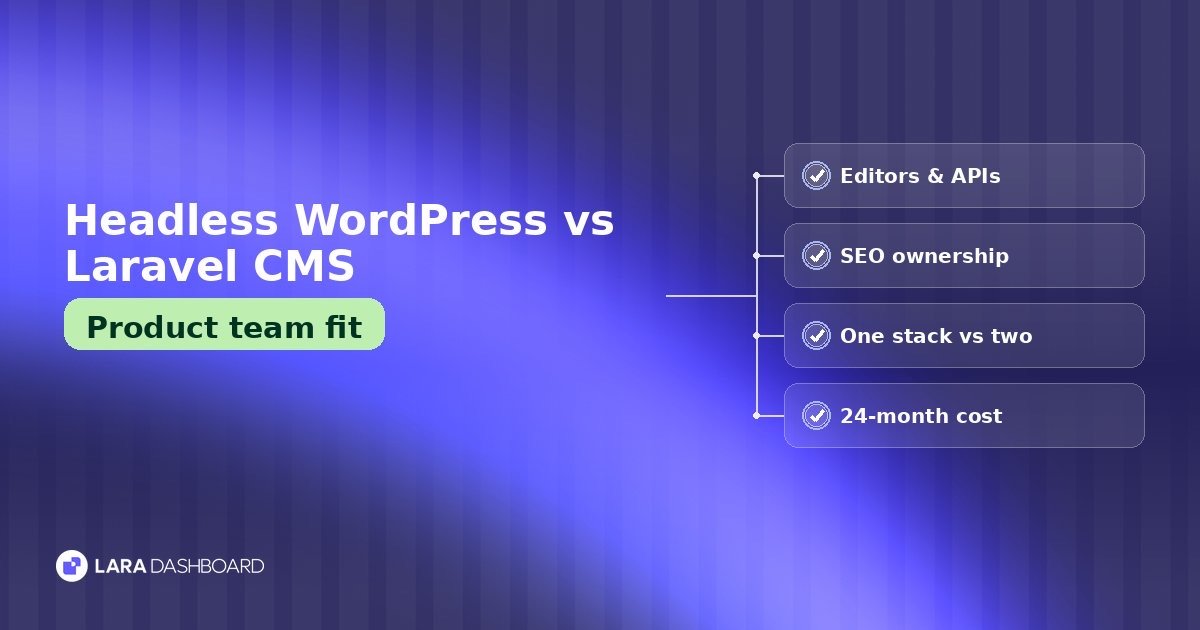
Cost over 12 to 24 months
Headless WordPress looks cheaper when you reuse existing content and plugins. Add hosting for WordPress, hosting for the frontend, preview environments, CDN rules, and dual monitoring. Plugin licenses still renew.
Laravel CMS concentrates cost in engineering time up front: content models, editor UX, migration, redirects. Ongoing cost is one deploy and one dependency tree. Migration checklists help; see WordPress to Laravel migration checklist.
Side-by-side comparison
Concern cheat sheet
Editor UI: Headless WordPress keeps familiar wp-admin / block editor. Laravel CMS uses a new admin with domain-shaped screens.
Content API: Headless WordPress uses WP REST / WPGraphQL. Laravel CMS uses Laravel routes / Sanctum APIs.
Product workflows: Best outside WordPress in the headless model. Native models, jobs, and policies in a Laravel CMS.
SEO ownership: Split across CMS + frontend when headless. Can stay in one Laravel app with a Laravel CMS.
Security surfaces: WordPress + frontend (+ bridge) when headless. Primarily one Laravel app with a Laravel CMS.
Plugin ecosystem: Huge for content on WordPress. Packages plus your code on Laravel.
Best fit: Headless WordPress for content-heavy sites with a separate product app. Laravel CMS for product + content in one stack.
When headless WordPress fits product teams
Choose headless WordPress when most of these are true:
- Editorial volume is high and staff refuse to leave WordPress.
- The product already runs (or will run) as a separate Laravel/Node app.
- Marketing owns a large URL library you do not want to migrate yet.
- You have engineers who can own preview, webhooks, and cache invalidation.
- Compliance allows WordPress in your stack with a clear patch process.
Watch for failure modes: duplicate auth, stale ISR caches after publish, and "temporary" custom plugins that become permanent.
When a Laravel CMS fits product teams
Choose a Laravel CMS when most of these are true:
- Roadmap items are workflows, roles, CRM-ish tools, and APIs more than brochure pages.
- You want one deploy, one policy system, and one place for audits.
- Editors can train on a focused admin for your content types.
- You prefer schema migrations over postmeta archaeology.
- Self-hosted control matters for data residency or integration depth.
LaraDashboard fits teams that want that Laravel-native CMS path with modules for content, media, roles, forms, and related ops. You still own hosting and hardening. Try the LaraDashboard site for product context, and what Lara Dashboard is for a feature overview.
Hybrid paths that reduce risk
You do not need a big-bang rewrite.
Keep WordPress for the blog, Laravel for the product. Share SSO or carefully linked accounts. Migrate high-value tools first (portals, billing admin, internal CRM).
Headless WordPress only for marketing, with Laravel owning authenticated app routes. Treat WordPress as a content service with SLAs.
Gradual content migration into LaraDashboard or another Laravel CMS after product features stabilize. Export, redirect, and verify search console coverage in phases.
Hybrids cost integration discipline. Write an ownership matrix: who owns URLs, who owns auth, who owns media, who owns incident response.
Migration notes if you leave headless WordPress
If you later consolidate into a Laravel CMS:
- Inventory content types, meta fields, and media.
- Map users and roles to Spatie-style permissions.
- Preserve URLs with a redirect table from day one.
- Rebuild preview and staging habits in Laravel.
- Retire WP REST consumers only after the new API is contract-tested.
Do not delete the WordPress database until redirects and analytics look clean for several release cycles.
Common objections
"Headless is required for performance." Cacheable marketing pages are fast on many stacks. Measure TTFB and cache hit ratio. Authenticated product UIs care more about query design than CMS brand.
"Laravel CMS means building WordPress from scratch." You rebuild the parts you need. You skip the parts you do not. A modular CMS shortens that path. You still write domain code.
"We will lose SEO." SEO breaks from bad redirects and split ownership, not from Laravel itself. Plan canonicals and sitemaps like a product launch.
"Editors will revolt." Sometimes they will. Pilot with one content type and a champion editor. Measure time-to-publish before a full cutover.
FAQ
Is headless WordPress still WordPress?
Yes. You still patch WordPress, manage plugins, and secure wp-admin or application passwords. The public theme layer is gone or minimal. The CMS remains a dependency.
Can LaraDashboard run headless too?
Yes in the API sense. You can expose content over Laravel APIs and render elsewhere. Many teams keep admin and public rendering in one app to avoid the dual-stack tax. Choose based on frontend strategy, not slogans.
What about WordPress VIP or managed WP plus Next.js?
Managed WordPress reduces ops toil on the CMS side. You still own frontend deploys, preview, and the product API. Budget for that full path.
How do we compare Filament or Nova vs LaraDashboard?
Filament and Nova are strong admin panel kits. LaraDashboard aims at a broader CMS and product module set (content, media, forms, tickets-style workflows depending on modules). Evaluate against your checklist: editorial needs, RBAC, and how much you want packaged vs custom.
Should startups start headless "for scale"?
Startups often need one stack and clear ownership. Headless adds moving parts. Add it when content teams and product teams truly need separation, not because a conference talk said so.
What is the fastest path off plugin-heavy WordPress?
If product logic is trapped in plugins, extract the product to Laravel first. Keep WordPress for content temporarily. Then decide whether content stays headless or moves into a Laravel CMS.
Ending note
Headless WordPress fits product teams that must keep wp-admin and already run product code elsewhere. A Laravel CMS fits teams that want content, roles, and product workflows in one Laravel deploy.
Score editor training, data model ownership, SEO URL control, security surfaces, hiring, and 24-month cost. Pick the architecture that matches how your team ships, not the one with the louder buzzword.
If you want a Laravel-native CMS path, explore LaraDashboard and the migration and security guides on the blog. If you stay on headless WordPress, invest in preview, cache purge, and a real product API outside the CMS. Either way, write the ownership matrix before you rewrite themes.