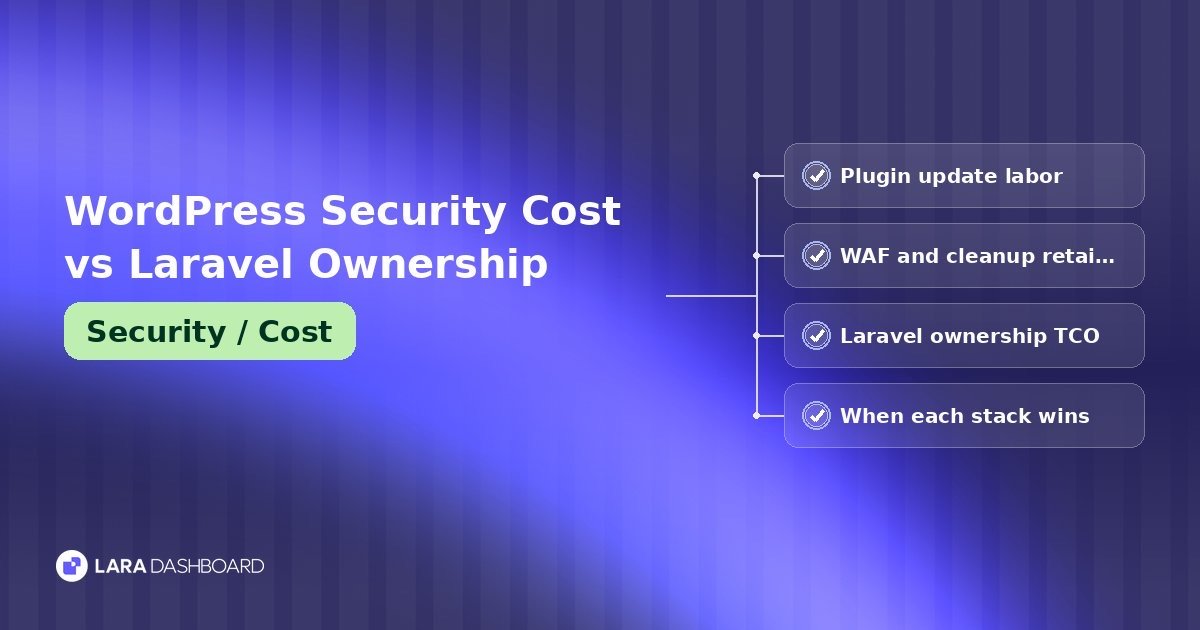
Your WordPress site still loads. The invoice for "security maintenance" keeps growing. Plugin updates, a WAF subscription, malware cleanup retainers, staging checks, and the odd emergency weekend all sit in one blurry line item. Teams then ask a sharper question: what does WordPress security maintenance really cost over a year, and when does owning a self-hosted Laravel CMS stack cost less in time and risk?
This article compares the total cost of ownership (TCO) of keeping WordPress secure versus owning a Laravel CMS you can patch on your own schedule. You will see concrete cost categories, when each stack wins, and how to budget without wishful thinking.
Disclosure: LaraDashboard is our open-source Laravel admin and CMS. We recommend it when you want a self-hosted Laravel stack with posts, roles, and related modules you control. The cost framing below still applies if you run Filament, Nova, or a custom Laravel app.
Related reading in this series: how to secure a self-hosted Laravel CMS, harden a Laravel CMS for production, auth, 2FA, and session security, backups, updates, and patching, and firewall, WAF, and rate limiting.
The short answer
WordPress security maintenance wins when your site is mostly content, your plugin list is short and well maintained, you already pay a careful agency or host that patches on a schedule, and a breach would hurt but not stop your product. You buy convenience and a large ecosystem. You also buy ongoing plugin CVE churn.
Laravel ownership wins when security work should follow your release process, you want fewer third-party PHP surfaces, your team already ships Laravel, and downtime or data loss hits revenue. You pay more up front for engineering habits. You spend less on surprise cleanup retainers if you keep the surface small.
Neither path is free. WordPress cost often hides in retainers and incident hours. Laravel cost often hides in the people who own deploys, secrets, and backups. Budget both.
What "security maintenance" means on WordPress
On many WordPress sites, "security" is not one product. It is a stack of habits and vendors.
Typical pieces:
- Core, theme, and plugin updates (manual or managed)
- A security plugin (Wordfence, Sucuri, Solid Security, or similar)
- Host-level or CDN WAF rules
- Malware scanning and cleanup retainers
- Staging or visual regression checks after updates
- User and role hygiene (especially for agencies with many editors)
- Backup storage and restore drills
- Occasional forensic work after a compromise
Official guidance from WordPress.org covers hardening and keeping software current. The gap is operational: who does the work every week, and what happens when a plugin ships a critical advisory on a Friday.
Why the bill feels larger than hosting
Shared or managed WordPress hosting looks cheap on the invoice. Security spend often lives elsewhere: an agency monthly, a Sucuri-style cleanup plan, premium plugin licenses, a Cloudflare or Sucuri WAF tier, and engineer overtime after an incident. Finance sees five vendors. Engineering feels one endless chore.
If you only track hosting, you undercount TCO.
Cost category 1: Plugin and theme update labor
WordPress security is tightly tied to update cadence. Each plugin is another release train. Themes and page builders add more. Compatibility testing after a major WooCommerce or Elementor update can take hours even when nothing is "broken" in a dramatic way.
Rough shapes teams actually see (illustrative ranges, not a quote):
- Solo site, 8-15 plugins, careful person: 2-6 hours per month
- Agency-managed brochure sites: baked into a $100-400/month care plan
- Product-adjacent WordPress (memberships, LMS, heavy forms): 8-20+ hours per month when staging and QA are real
Labor is the largest recurring cost for many teams. Licenses are visible. Hours are not.
Laravel does not remove updates. Composer packages and Laravel framework releases still need attention. The difference is concentration: fewer random PHP entry points from "install this plugin," and updates usually go through the same CI and staging path as features. See our notes on backups, updates, and patching.
Cost category 2: WAF, CDN, and edge rules
A web application firewall (WAF) sits in front of the app and filters abusive traffic. On WordPress, many teams buy this because plugin bugs and xmlrpc or login abuse are common. Cloudflare, Sucuri, and host WAFs are typical.
Annual costs vary by traffic and plan. Small sites may sit in the tens of dollars per month. Product sites often move into paid tiers for better rules, bot management, and logging.
Laravel sites benefit from the same edge layer. Ownership does not mean "skip the WAF." It means you can pair edge rules with app-level rate limiting and auth controls you understand. We walk through that stack in firewall, WAF, and rate limiting for LaraDashboard.
Budget WAF on both sides. Do not count it only against WordPress.
Cost category 3: Malware cleanup and incident retainers
This is where WordPress TCO spikes. A compromised plugin, a stolen admin password, or an abandoned theme can lead to spam injections, SEO spam, or crypto miners. Cleanup vendors sell one-time cleans and annual plans.
Illustrative market shapes (check current vendor pricing before you budget):
- One-time malware removal: often a few hundred dollars per incident
- Annual cleanup / monitoring retainers: commonly mid-three to low-four figures per year depending on vendor and sites covered
- Internal incident: one or more engineer-days plus reputation work
Laravel ownership does not make compromise impossible. A leaked
.env, an open debug page, or a bad package can still hurt. The failure modes shift toward secrets, misconfigured servers, and app bugs you shipped. Incident cost becomes "restore from backup and rotate keys" more often than "scan thousands of PHP files for injected eval." That only holds if backups and deploy discipline are real.Cost category 4: Downtime and SEO recovery
Security events create downtime costs that never appear as a security line item.
Examples:
- Site in search quarantine after spam
- Checkout or lead forms offline during cleanup
- Forced password resets for all users
- Agency fire drill that delays roadmap work
Put a simple number on revenue or lead value per hour. Multiply by realistic outage hours for a bad incident. Even a conservative estimate changes the "WordPress is cheaper" story for product teams.
Laravel ownership moves downtime risk into deploy and ops quality. A bad migration can take you down too. The mitigation is the same on both stacks: staging, backups, and a practiced restore. Our production hardening guide covers the Laravel side of that baseline.
Cost category 5: Access control and admin surface
WordPress admin is a large, well-known target. Shared logins, leftover contractor accounts, and weak passwords show up in incident reports year after year. Security plugins add 2FA and login limits. That helps. You still maintain users across plugins that each store their own capabilities.
Laravel apps use gates, policies, and often Spatie-style roles. You design fewer public admin routes if you are careful. You still need 2FA, session hardening, and password rules. See auth, 2FA, and session security.
Cost here is mostly process: who reviews access quarterly, and how fast you revoke contractors. WordPress care plans sometimes include that review. Laravel teams must put it on a calendar themselves.
Cost category 6: Hosting, PHP, and OS patching
Managed WordPress hosts patch the OS and often PHP for you. That is real value. VPS self-hosting for WordPress or Laravel means you (or a platform) own OS updates, TLS, and disk.
Self-hosted Laravel on a VPS or container platform often looks more expensive per month than budget WordPress hosting. Compare carefully:
- Managed WP: lower ops hours, less control, host-level constraints
- VPS / PaaS Laravel: higher base bill or higher skill need, full control of runtime
If your team already runs Laravel apps, the incremental cost of one more Laravel CMS may be small. If nobody on staff has touched Linux in years, WordPress managed hosting may still win on ops cost even when plugin risk is higher.
A practical TCO cheat sheet (prose form)
Use this as a planning scorecard. Numbers are categories to fill with your invoices, not universal prices.
Update labor: WordPress scales with plugin count and page-builder risk. Laravel scales with Composer deps and release discipline.
Security product licenses: WordPress often pays for a security plugin plus cleanup plan. Laravel often pays for monitoring and error tracking you may already own.
WAF / CDN: Both stacks should budget an edge layer for public sites.
Incident cleanup: WordPress more often buys malware-specific cleanup. Laravel more often spends on forensic time plus secret rotation.
Downtime value: Product and ecommerce sites should weight this heavily on both sides.
People cost: WordPress may buy an agency retainer. Laravel may buy engineer allocation (or a smaller retainer for a Laravel-friendly ops partner).
Migration / rewrite: Switching stacks has a one-time cost. Do not pretend a rebuild is free security spend. Use the migration checklist if you move content and SEO with intent.
Best fit: WordPress when content ops and managed care dominate. Laravel when your product team already owns the runtime and wants a smaller PHP surface.
When WordPress security maintenance still wins
Stay on WordPress (with eyes open) when most of these are true:
- The site is marketing content, not the core product database
- Plugin count stays low and vendors are active
- You already pay a competent managed host or care plan that patches weekly
- Editors must stay in wp-admin and refuse a new admin
- You can tolerate a cleanup retainer as insurance
- Nobody on staff will own Laravel deploys for the next year
In that case, cut risk inside WordPress: fewer plugins, 2FA, least privilege, staging updates, offsite backups, and a WAF. Do not "save money" by skipping updates.
Headless WordPress for the blog while the product lives in Laravel can also be a sane split. See headless WordPress vs Laravel CMS.
When Laravel ownership wins on security cost
Plan toward Laravel ownership when most of these are true:
- Plugin update theater burns more hours than feature work
- You have had one or more malware or SEO-spam incidents
- Product data already wants real models, not CPT + postmeta (see custom post types vs Laravel models)
- Your engineers already ship Laravel with CI, staging, and migrations
- You want auth, roles, and admin routes under policies you test
- Finance will fund a rebuild once, but hates surprise retainers forever
Ownership is not "set and forget." It is "we control the patch window." That only saves money if someone owns the checklist: dependencies, server images, secrets, backups, and rate limits.
How LaraDashboard fits (honest disclosure)
LaraDashboard is a modular, self-hosted Laravel CMS and admin. Blog posts, media, roles, and optional modules (contacts, tickets, forms, and similar, depending on what you enable) live as Laravel code and Eloquent models rather than a long WordPress plugin chain.
What that means for security cost:
- You inherit Laravel's update and deploy habits instead of dozens of plugin UIs
- You still must harden the host, TLS, backups, and auth. We document that path in the security series linked above
- You should still put a WAF or CDN in front of public traffic
- You avoid WordPress-specific malware cleanup products, but you do not avoid general incident response
- Open-source software does not erase ops work. It moves work into your engineering process
We recommend LaraDashboard when you want that Laravel ownership model with a ready admin shell. We do not claim it is cheaper than WordPress for every brochure site. For a product overview, see what LaraDashboard is. For modular structure, see building modular Laravel applications.
If you rebuild for rankings and redirects, pair this cost discussion with how to rebuild a WordPress site in Laravel without losing rankings.
A 90-day cost decision walkthrough
Step 1: Export last year's security spend
List every invoice tagged security, care plan, WAF, cleanup, premium security plugins, and emergency hours. Add estimated internal hours at a loaded engineer rate. That is your WordPress security TCO baseline.
Step 2: Count attack surface
Count active plugins, abandoned plugins, admin users, and XML-RPC or unused REST exposure. Abandoned plugins are future incident fuel.
Step 3: Price Laravel ownership for your team
Include hosting or PaaS, monitoring, WAF (same as today if you keep it), and monthly engineer hours for Composer and OS patches. Add a one-time migration budget if you would move.
Step 4: Stress-test one incident
Pick a three-day outage or SEO-spam event. Estimate revenue and recovery cost on WordPress today. Estimate the same on a Laravel stack with known-good backups. Compare.
Step 5: Choose a lane for 12 months
Options that work in practice:
- Stay on WordPress and fund proper maintenance (do not underfund)
- Hybrid: WordPress for marketing, Laravel for product and admin
- Rebuild the CMS on Laravel (LaraDashboard or another stack) with a redirect and content plan
Write the choice down. Revisit after the next major incident or plugin scare, not after every blog post about WordPress being "dead."
Failure cases to avoid
- Counting only hosting and calling WordPress "cheap"
- Moving to Laravel with no backup or staging culture (you will recreate downtime another way)
- Installing twenty Laravel packages to recreate a plugin zoo
- Skipping 2FA because "we are small"
- Assuming a WAF replaces updates
- Rebuilding for security while ignoring SEO redirects and content ownership maps
Security cost follows habits more than logos.
FAQ
Is WordPress insecure by default?
No. WordPress can be run carefully with updates, least privilege, and a small plugin set. Risk rises with abandoned plugins, shared admin access, and delayed patches. The cost problem is often operational load, not a single fatal flaw.
Is Laravel automatically cheaper to secure?
No. Laravel is cheaper to secure when your team already owns deploys and keeps dependencies tight. It is more expensive when nobody will patch the server or review Composer updates. Ownership without owners is just unpaid debt.
Do I still need a WAF on Laravel?
For public sites, yes in most cases. App-level rate limiting and auth help. Edge filtering still blocks a lot of noise before it hits PHP. Budget it on both stacks.
What about managed WordPress security plans?
They can be worth it for content sites. Read what the plan covers: updates only, malware cleanup, uptime SLA, or all three. Compare that retainer to internal Laravel ops hours honestly.
Can I migrate only for security reasons?
You can, but pair security goals with architecture goals. If CPT-heavy product data is already painful, a move may pay twice. If the site is a simple blog, harden WordPress first and revisit later.
How does LaraDashboard change the security bill?
It shifts work into Laravel ownership: framework and module updates, host hardening, backups, and auth policies. It removes a large class of WordPress plugin CVE churn. It does not remove the need for disciplined ops. We disclose that because we build LaraDashboard.
Ending note
WordPress security maintenance cost is real, recurring, and easy to undercount. Laravel ownership cost is real too, and it shows up as people and process. Pick the stack that matches who will do the work for the next twelve months.
If you want a self-hosted Laravel CMS with a clear admin and modular path, try LaraDashboard. Use the security series above as your hardening checklist either way. If this matched a budget fight you are having, tell us which cost category surprised you most.