You keep seeing laravel vs wordpress threads that end in a scoreboard. One camp lists plugins. The other lists frameworks. You still do not know what to pick for your site or product.
The usual question is wrong. "Which is better?" assumes they compete for the same job. They often do not.
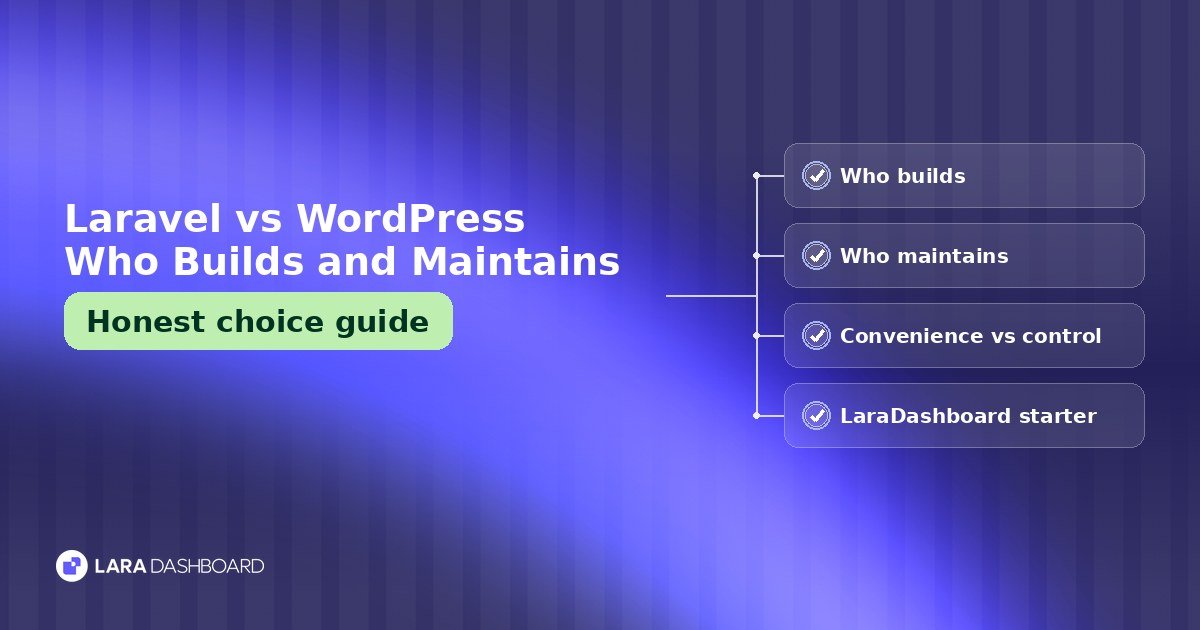
The sharper pair of questions is: who builds it, and who maintains it. Those two answers usually decide the stack before feature checklists do.
If you want the 2026 feature duel (performance ceilings, SEO plugins, cost ranges, scalability, headless hybrids), read our existing Laravel vs WordPress post. The focus here stays on builder/maintainer fit and convenience versus control.
Disclosure: LaraDashboard is our open-source Laravel admin and CMS. We mention it where a Laravel starter reduces auth, roles, posts, media, and settings work. The decision framework still applies if you use Filament, Nova, or a custom Laravel app.
Laravel vs WordPress: the short answer
Choose WordPress when a non-technical person must build and update the site. A small content team without a developer on call also fits. You want themes, plugins, and a familiar editor more than you want custom architecture.
Choose Laravel when you are building software: custom workflows, APIs, SaaS logic, or requirements that will keep changing. You accept that a developer (or a team) owns the codebase and the release process.
Neither replaces the other. WordPress is not a failed Laravel. Laravel is not a WordPress clone with extra steps.
Convenience and control pull in opposite directions. Pick the trade-off you can live with for years, not the slogan that wins a comment thread.
Laravel vs WordPress at a glance: convenience vs control
Use this as a planning scorecard. Fill the "who" columns with real names on your team.
Primary job
WordPress: publish and manage content with less custom code.
Laravel: build application behavior you design yourself.
WordPress: publish and manage content with less custom code.
Laravel: build application behavior you design yourself.
Who usually builds
WordPress: site owner, marketer, agency on themes/plugins, light PHP when needed.
Laravel: PHP/Laravel developer or product engineering team.
WordPress: site owner, marketer, agency on themes/plugins, light PHP when needed.
Laravel: PHP/Laravel developer or product engineering team.
Who usually maintains
WordPress: whoever updates core, themes, and plugins (you, a care plan, or a host).
Laravel: whoever owns deploys, Composer updates, tests, and server/runtime hygiene.
WordPress: whoever updates core, themes, and plugins (you, a care plan, or a host).
Laravel: whoever owns deploys, Composer updates, tests, and server/runtime hygiene.
Convenience
WordPress: high at the start. Install, pick a theme, add plugins, publish.
Laravel: lower at the start. You scaffold and ship features on purpose.
WordPress: high at the start. Install, pick a theme, add plugins, publish.
Laravel: lower at the start. You scaffold and ship features on purpose.
Control
WordPress: high inside the CMS model; awkward when logic fights that model.
Laravel: high over data, auth, jobs, and APIs; you own the shape of the app.
WordPress: high inside the CMS model; awkward when logic fights that model.
Laravel: high over data, auth, jobs, and APIs; you own the shape of the app.
Best default
WordPress: brochure sites, blogs, marketing content, standard stores with a clear plugin path.
Laravel: custom apps, SaaS, internal tools, products where the database is the product.
WordPress: brochure sites, blogs, marketing content, standard stores with a clear plugin path.
Laravel: custom apps, SaaS, internal tools, products where the database is the product.
Middle path
A Laravel foundation with a ready admin/CMS layer (we build LaraDashboard for that). You still need Laravel skills. You skip rebuilding users, roles, posts, media, and settings from zero.
A Laravel foundation with a ready admin/CMS layer (we build LaraDashboard for that). You still need Laravel skills. You skip rebuilding users, roles, posts, media, and settings from zero.
When WordPress fits (no developer on staff)
If nobody on your team writes PHP, WordPress is usually the honest default. That covers founders, freelancers, nonprofits, and local businesses.
You can install it, choose a theme, and publish pages without learning MVC. Editors stay in a UI they already know. Plugins fill gaps: forms, SEO helpers, memberships, light ecommerce.
That is not laziness. It is matching the tool to the people who will touch it every week.
Choose wordpress or laravel becomes simple here: if the maintainer cannot open a terminal, do not start with a framework. Hiring a Laravel developer "just for launch" and then leaving the app with a non-technical owner is how projects stall.
WordPress also wins when the site is mostly content. Think marketing pages, a blog, event updates, or a catalog that fits WooCommerce without exotic rules. Your risk is plugin and update discipline, not inventing a new data model every sprint.
For migration triggers that push teams away from WordPress later, see why developers are moving from WordPress to Laravel. That post covers the "we outgrew plugins" story. The question here is whether you should start there at all.
The trade-off: ecosystem convenience becomes maintenance surface
WordPress convenience is real. So is the bill that arrives as dependency noise.
Every plugin is another release train. Themes and page builders add more. Compatibility checks after a major update can take hours even when nothing looks broken. The site still "works," yet someone is babysitting version numbers.
Think of maintenance as a dependency stack problem, not a moral failure. You did not pick a bad platform. You picked a platform where third-party PHP runs next to your content by design.
That stack is fine when:
- Plugin count stays short
- Vendors stay active
- Someone owns weekly updates
- A care plan or managed host does the boring work
It gets expensive when:
- Plugins multiply for every small feature
- Abandoned plugins sit on production
- Page builders and ecommerce plugins clash
- Nobody owns staging checks after updates
Laravel does not erase dependencies. Composer packages and framework releases still need attention. The difference is concentration and process. Updates usually ride the same CI and staging path as features, instead of twenty separate plugin UIs.
For the money side of that trade-off (retainers, cleanup, WAF, ownership hours), read WordPress security maintenance cost vs Laravel ownership. We keep cost tables out of this article on purpose.
Security myths: control is not magic
You will hear "WordPress is insecure" and "Laravel is safe by default." Both slogans are lazy.
WordPress core is maintained by a large project with a security team. Most painful incidents still come from outdated plugins, abandoned themes, weak admin habits, and missed updates.
Popularity makes it a target. Targets attract scanners. That is not the same as "core is useless."
Laravel gives you CSRF protection, hashed passwords, and query builders that help against SQL injection when you use them correctly. It does not make your app unhackable. A leaked
.env, an open debug page, a bad package, or a missing authorization check will still hurt.The real advantage is control. On Laravel you decide which code runs, which routes exist, and how roles map to actions. On WordPress you inherit a large admin surface and a plugin market.
You can harden either stack. You cannot skip ownership.
LaraDashboard is not "unhackable" either. It is Laravel code you can patch, review, and deploy on your schedule. You still need TLS, backups, least privilege, and update discipline. Call the myth what it is: marketing, not architecture.
Laravel for custom applications and software products
Pick Laravel when you are shipping software, not only pages.
Examples that fit:
- Multi-step workflows that do not map to posts and pages
- APIs for mobile or partner integrations
- Billing, seats, meters, and plan gates
- Complex roles that belong in policies, not a pile of capability plugins
- Background jobs, queues, and domain events
- Data models that grow with the product
See custom post types vs Laravel models if you are hitting CPT walls.
WordPress can stretch into some of these with enough plugins and custom PHP. Stretching is the tell. When every new feature fights the CMS model, you are paying convenience tax forever.
Laravel for non developers is usually the wrong framing. Laravel is for teams that include developers (or will hire them). If your product is the application, that hire is part of the business, not an optional extra.
If product teams are weighing headless content vs a Laravel CMS admin, see headless WordPress vs Laravel CMS.
Laravel is not automatically secure
Repeating this because it gets skipped in "framework wins" posts.
You still must:
- Keep Laravel and packages current
- Lock down the server or PaaS
- Store secrets outside the repo
- Use HTTPS everywhere
- Enforce strong auth (and 2FA where it matters)
- Test authorization on every sensitive action
- Back up and practice restores
Framework defaults help. Habits decide outcomes. A messy Laravel app with debug left on can be worse than a carefully maintained WordPress site on a managed host.
If you want the ownership checklist path, start with our security series linked from the TCO post above. Do not treat "we use Laravel" as a compliance badge.
Performance, briefly: you decide what runs
We will not replay Core Web Vitals lectures here. The existing Laravel vs WordPress post already covers that lane.
The builder/maintainer angle is simpler: performance follows what you allow to run.
On WordPress, speed often depends on hosting, caching plugins, and how many plugins execute on every request. You can get fast results. You also inherit other people's code paths.
On Laravel, you start leaner because you only add what you build or install on purpose. That can mean fewer surprise queries. It can also mean a slow app if your team writes N+1 queries and skips caching. Control cuts both ways.
For content sites with modest traffic, WordPress on good hosting is often "fast enough."
For application workloads, you tune queries, queues, and responses yourself. Laravel's control matters more than a slogan about frameworks being faster.
The barrier: Laravel usually needs a developer
Here is the honest blocker for many readers searching laravel for non developers.
Without someone who knows PHP, Composer, migrations, and deploys, Laravel is not a DIY CMS. Tutorials will not replace ongoing ownership. If your plan is "launch on Laravel, then maintain it ourselves with no engineering," stop and choose WordPress (or hire for real).
Where starters help is the first months of boilerplate, not the need for skill.
Where LaraDashboard sits (disclosure)
Disclosure again, clearly: LaraDashboard is our product. It is a modular Laravel admin and CMS. It does not turn a non-developer into a Laravel engineer. It reduces starter work so a developer is not rebuilding the same admin shell on every project.
Common modules and building blocks people expect out of the box:
- Users and authentication flows
- Roles and permissions
- Posts / content management
- Media library
- Settings
- Forms and related admin utilities (depending on what you enable)
You still write the product logic that makes your app yours. You skip weeks of re-implementing auth screens, role UIs, post CRUD, and media uploads.
For product context, read what LaraDashboard is. For how features stay isolated as modules, read building modular Laravel applications with Lara Dashboard.
If you only need a brochure site and have no developer, LaraDashboard is the wrong recommendation. WordPress (or a hosted website builder) fits better. We would rather lose that lead than sell you a stack you cannot maintain.
Ecosystems differ: plugins vs building blocks
WordPress and Laravel both have ecosystems. They are not the same shape.
WordPress plugins are often end-user features. Install, configure in wp-admin, ship. The buyer is frequently a site owner.
Quality varies. Updates are a lifestyle.
Laravel packages are often developer building blocks. Auth scaffolding, permissions, queues, billing SDKs, admin panels. The buyer is a developer who wires them into an app. You still own integration and upgrades.
Neither ecosystem is "better" in the abstract. Plugins optimize for speed-to-feature for non-coders. Packages optimize for composition under version control.
When you choose WordPress, you are betting that plugin composition stays cheaper than custom code. When you choose Laravel, you are betting that custom composition stays cheaper than fighting CMS boundaries.
Agencies feel this daily. A WordPress care plan sells update labor. A Laravel retainer sells feature and ops labor. Price the labor you actually need.
Decision questions checklist
Answer these in writing before you buy a theme or scaffold an app.
- Who will publish content next month? Name the person.
- Who will fix a broken update at 9pm? Name the person or vendor.
- Is the database mostly pages/posts, or is it product state? Be honest.
- Will requirements stay mostly stable, or will workflows keep changing?
- Do we already have Laravel skills on staff or budget to hire them?
- Are we OK owning deploys, Composer, and backups?
- Is "install a plugin" our preferred feature process?
- Would a security incident hit content reputation, or would it hit customer data and billing?
- Are we choosing familiarity, or fit? Familiarity is not a strategy.
- If we outgrow the choice in 18 months, which migration hurts less for this team?
If questions 1-2 point to non-technical owners and question 5 is "no," WordPress wins. If questions 3-4-6 point to product software and engineering ownership, Laravel wins.
Choose WordPress when
- Non-technical owners must build and edit without a developer
- The site is content-first (marketing, blog, simple brochure)
- You want themes and plugins more than custom architecture
- A managed host or care plan will own updates
- Budget prioritizes fast launch over long-term custom logic
- Editors refuse to leave a familiar admin
Stay clear-eyed: keep the plugin list short, use 2FA, and do not skip updates.
Choose Laravel when
- You are building an application or SaaS, not only a site
- Requirements will evolve in ways plugins cannot express cleanly
- Developers (or a partner team) will own the codebase
- You want auth, roles, APIs, and jobs under code you test
- Dependency updates should follow your release process
- You accept higher start cost for control over the long run
Then decide how you start Laravel. You can build a greenfield admin from scratch. You can use Filament or Nova-style panels. Or use a CMS-oriented starter like LaraDashboard when content, roles, and media are part of the product admin.
Ending note: Laravel vs WordPress by ownership
Laravel vs WordPress is not a popularity contest. It is a staffing and ownership decision dressed up as a tech debate.
If who builds and who maintains are non-technical, choose WordPress and treat plugins as a maintenance surface you budget for. If who builds and who maintains are developers shipping product logic, choose Laravel and treat control as work you must actually do.
Neither stack replaces the other. Convenience and control trade places. Pick the trade-off your named humans can carry.
If you want a Laravel foundation without rebuilding auth, roles, CMS, settings, and media from scratch, start with LaraDashboard. Try the demo or laradashboard.com. One click path, no second pitch.
FAQ
Is Laravel better than WordPress?
No universal winner. WordPress fits content sites maintained by non-developers. Laravel fits custom applications maintained by developers. "Better" without who builds and who maintains is noise.
Can a non-developer use Laravel?
Not as a day-to-day CMS replacement for WordPress. Non-developers can use an admin UI a developer built on Laravel. They should not be expected to install, upgrade, and debug a Laravel app alone. For true DIY without a developer, WordPress (or a hosted builder) is the practical path.
Is WordPress insecure?
WordPress core is not "insecure by nature." Risk often comes from outdated plugins, weak admin practices, and missed updates. Managed carefully, many content sites are fine. Ignore updates and the story changes.
Is Laravel automatically secure?
No. Laravel provides solid defaults and tools. Misconfiguration, leaked secrets, and missing authorization checks still cause breaches. Control helps only if your team uses it.
When should I choose WordPress or Laravel for a small business site?
If the site is mostly pages, blog posts, and light forms, and no developer is on staff, choose WordPress. If the "site" is actually a custom portal with accounts, workflows, and API integrations, choose Laravel and budget for engineering.
Does LaraDashboard replace WordPress for non-technical users?
No. LaraDashboard is for teams that already want Laravel. It lowers boilerplate for developers.
It is not a no-code WordPress substitute. We disclose that because the wrong fit wastes everyone's time.
What about cost and SEO plugins?
We covered cost ranges, SEO plugin depth, and scalability ceilings in the June 2026 Laravel vs WordPress guide. Those tables stay there so you can focus here on builder/maintainer fit.
Can I use both?
Yes, in some architectures: WordPress for editorial content and Laravel for the product, including headless setups. That is a team and ops choice, not a free lunch. See the headless comparison linked above before you split stacks.